
We the Nuclear Free North
Our resistance continues! We oppose the nuclear industry’s stated intention to bury all of Canada’s nuclear fuel waste in northern Ontario.
Our voices, together, are powerful. Join us!
The Federal Impact Assessment for the NWMO’s planned DGR project has begun
The clock is ticking on the 30-day comment period.
A federal review of the Nuclear Waste Management Organization’s (NWMO’s) nuclear waste transportation and burial project was launched on Jan. 5 with a 30-day comment period on the NWMO’s Initial Project Description closing on Feb. 4. Read more HERE.
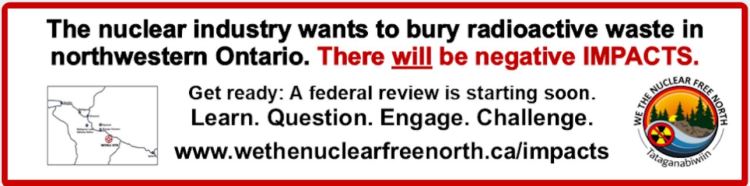
Your voice is important – please submit your comment calling for a full impact assessment and public hearing and insisting that transportation be included and thoroughly considered in the review (the NWMO intends to send 2-3 trucks per day for fifty years; trips will average 1,800 km over mostly two-lane public roads, travelling from nuclear generating stations in southern Ontario and eastern Canada to the NWMO’s proposed site in the headwaters of the Wabigoon River in northwestern Ontario).
Make sure you have your say!
Visit our Impacts webpage to learn how to comment. It’s easy!
The big twist: The NWMO wants transportation excluded from the federal impact assessment. Thus, as revealed on Jan. 5, the NWMO has not included transportation in their Initial Project Description for their planned deep geological repository project between Ignace and Dryden, in NW Ontario.
The nuclear industry has correctly characterized transportation as part of the project since planning began, decades ago. Why move now to have transport excluded from examination? Likely because the dangers of transportation are substantial, poorly addressed by the nuclear industry, and could subject the project to an unwelcome level of scrutiny in the Impact Assessment process.
There are easy, effective ways to respond to this, and to other shortcomings in the Initial Project Description. During the comment period, let the Agency know that transportation needs to be included in a full Impact Assessment with a pubic hearing. You may also simply let the Impact Assessment Agency know your more general concerns about the NWMO’s DGR project. Let’s hinder the nuclear industry’s efforts to cut corners. Visit our Impacts webpage for updates and details on actions you can take today!
Sign up for our contact list to receive news and analysis throughout the review process.
Tataganabiwiin
Our alliance is honoured to have received the name Tataganabiwiin: looking far ahead into the future. Learn about who we are, and the origin and meaning of this name, which may be used by all people working together to protect Aki (Mother Earth).
The Resistance Continues:
make a resolution!
As we continue in our resistance to the nuclear industry’s plan, resolutions of opposition from communities and organizations continue to be vital.
Many communities bear exactly the same risk from potential transportation of nuclear fuel waste as Ignace. Community voices are shouting: we are NOT willing! Communities in the project’s extensive watershed are also at risk.
You can pass a resolution against the NWMO’s plan. See our Resolutions and Statements page for a sample resolution copy and a list of resolutions.
Book a presentation
You can request volunteers from We the Nuclear Free North to do a presentation (Zoom or in-person) on the risks of nuclear waste transport and burial, for your private or public group. All information is from referenced sources. Discussion is encouraged!
Email: nuclearfreenorth@gmail.com, or call: 1-855-225-8055 (toll free)
Who we are
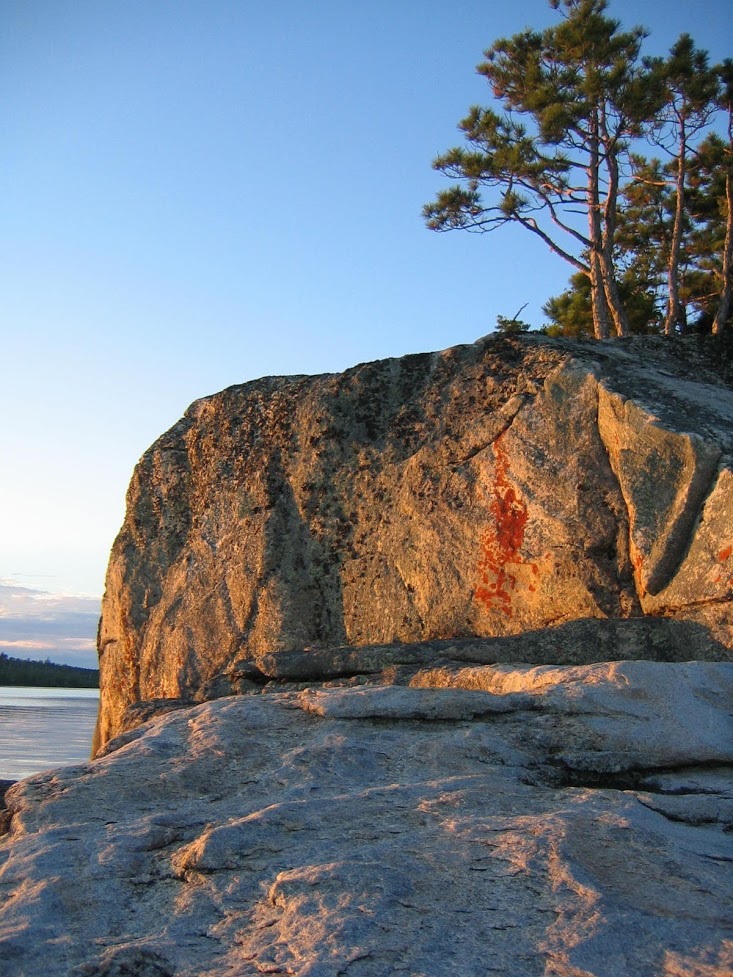
We the Nuclear Free North is an alliance of people and groups opposed to transporting, burying and abandoning all of Canada’s nuclear fuel waste in Northern Ontario. Read more.
The issue
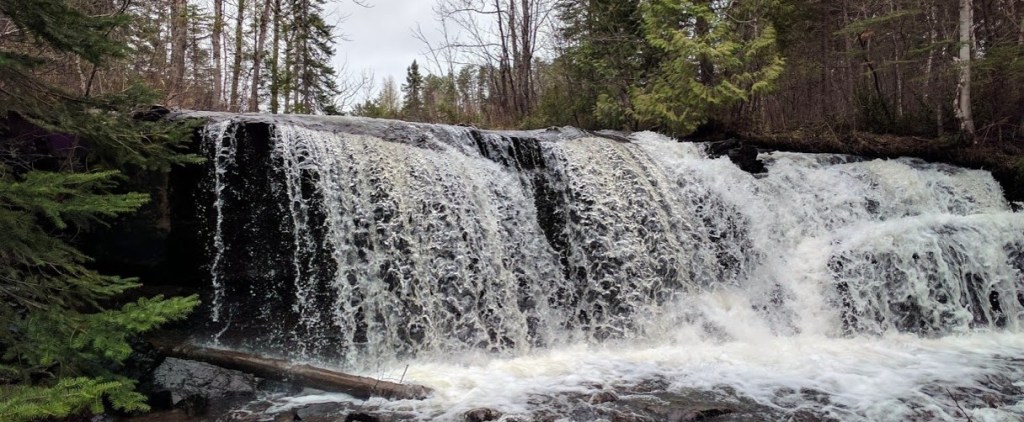
Canada’s nuclear industry makes up the members of the Nuclear Waste Management Organization (NWMO). The NWMO has chosen a location is just south of the TransCanada Highway, between Ignace and Dryden in NW Ontario, to bury an abandon all of Canada’s nuclear fuel waste. If the plan proceeds, an estimated 100,000 tonnes of highly radioactive nuclear fuel waste would be shipped to the selected site, repackaged, buried, and abandoned by 2188. Learn more about the nuclear waste abandonment issue.
You can help
Spread the word about these “disposal” plans. Speak to your elected representatives. Write your local paper. Make a donation to our efforts. Oppose the NWMO loudly. Contact We the Nuclear Free North – we’ll work together.
Our primary concerns
- Informed consent, or “willingness”.
How has “consent” been defined? Who has been consulted? Has the process been just and democratic? - Lack of scientific evidence for safety of burial.
The stakes are high – can we experiment? A mistake could contaminate our waterways for hundreds of thousands of years. - Dangers of transportation and repackaging.
Dangerous waste will be transported up to 2,517 km, and the highly radioactive and hazardous material unpacked and repackaged on-site.
We believe that responsible stewardship of these wastes close to the sites of their production is the best management alternative.
How am I at risk?
Those along the transport routes are at risk from both incidental gamma ray exposure and consequences of container breach from collisions.
Radioactive fuel waste will be repackaged on-site, an extremely risky procedure that could release radioactive material on the surface, where it could move into local waterways.
Radioactive fuel waste will be buried in the bedrock – something that has never been done before, and for which there is scant evidence of safety. If containment fails, radioactive material could be released into NW Ontario watersheds, eventually reaching Lake Winnipeg and Hudson Bay.
Read more: Nuclear Waste and Health
Local residents are concerned
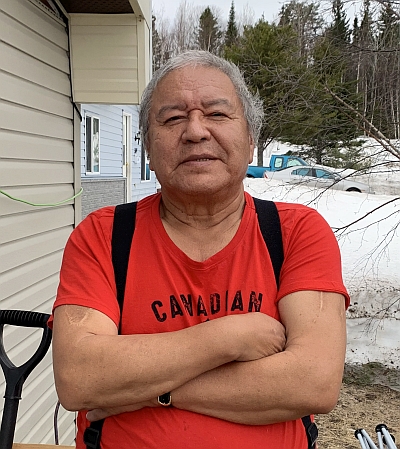
“The whole thing will fail. It might take a thousand years, but it will fail. No matter what kind of a container, no matter how solid that container you put into the ground, sooner or later it will rot and it will break – and whatever is in it will spread.”
Elder Roy Ignace
Resident of Ignace, Ontario
Take-aways
- The NWMO is not a public agency – it is a group of nuclear power companies
- there is no operating DGR anywhere in the world, and therefore no operating experience the nuclear industry can point to
- The highly radioactive wastes will be transported by truck or rail for thousands of kilometres
- There is no safe level of exposure to radiation
- Certain radioactive components of nuclear waste are water soluble
Would you like to spread the word with a t-shirt or lawn sign?
Please visit our Etsy store!
Visit We the Nuclear Free North’s YouTube channel.
 We the Nuclear Free North